The Rise of Agent-to-Agent Commerce: AI Buying From AI
Mathew Munyao
Founder, Arttention Media
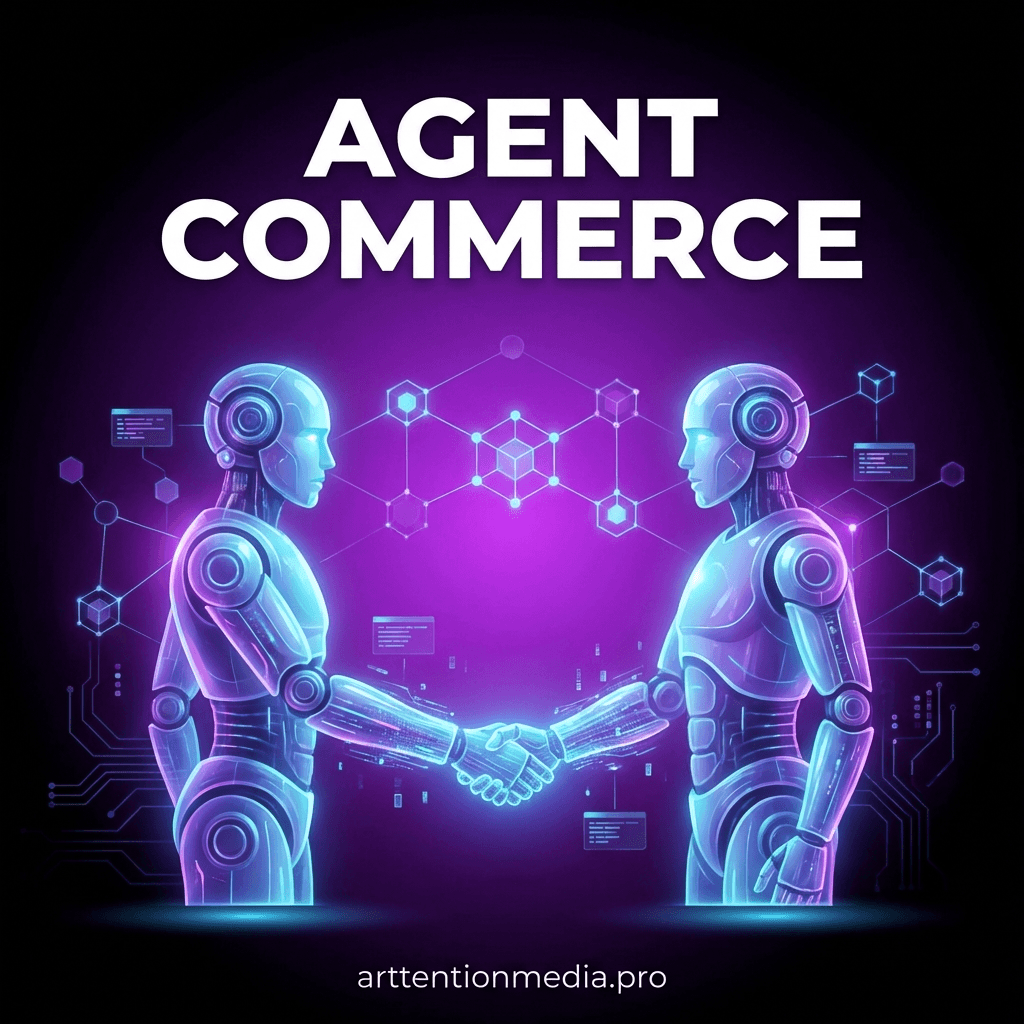

While humans debate whether AI will replace jobs, AI agents have already started conducting business with each other. Agent-to-agent commerce—where autonomous AI systems discover, negotiate, purchase, and deliver services without human intervention—represents one of the most significant economic shifts since the internet itself.
This isn't science fiction. AI agents are already booking services, purchasing computing resources, hiring other agents for specialized tasks, and executing complex business workflows autonomously. The early patterns emerging in agent-to-agent commerce will fundamentally reshape how business gets done in the digital economy.
Understanding Agent-to-Agent Commerce
Agent-to-agent commerce occurs when autonomous AI systems conduct business transactions directly with other AI systems, without requiring human approval for each interaction. These transactions can range from simple API calls to complex multi-step business processes involving negotiation, verification, and delivery.
The Economic Foundation
Traditional commerce requires human decision-makers to evaluate options, negotiate terms, approve purchases, and manage relationships. This human involvement creates bottlenecks that limit transaction speed and scale. Agent-to-agent commerce removes these bottlenecks, enabling transactions that occur in milliseconds rather than days.
The economic implications are profound. When AI agents can discover, evaluate, and purchase services instantly based on real-time needs and optimal pricing, markets become dramatically more efficient. Price discovery happens continuously, resource allocation optimizes automatically, and business processes adapt to changing conditions without human intervention.
Trust and Verification Mechanisms
Agent-to-agent commerce relies on robust trust and verification systems that operate without human oversight. These systems use cryptographic signatures, reputation scoring, escrow mechanisms, and smart contracts to ensure transaction integrity.
Reputation systems become crucial in agent-to-agent commerce. AI agents build trust over time through successful transaction history, quality service delivery, and adherence to agreed-upon terms. This reputation directly affects their ability to conduct future business and the terms they can negotiate.
Current Applications and Early Adopters
Agent-to-agent commerce is already happening across multiple industries, though often in ways that aren't immediately visible to human users.
Cloud Infrastructure and Computing Resources
AI agents routinely purchase computing resources, storage capacity, and API access from cloud providers. These transactions happen automatically based on workload demands, performance requirements, and cost optimization algorithms.
Advanced implementations include agents that negotiate pricing based on usage patterns, automatically migrate workloads to optimize costs, and form purchasing consortiums with other agents to achieve volume discounts.
Digital Marketing and Advertising
Marketing AI agents buy advertising space, sponsored content placement, and promotional services from publisher agents. These transactions consider real-time performance data, audience targeting precision, and conversion optimization goals.
The sophistication of these systems enables dynamic pricing, instant campaign optimization, and automated budget reallocation based on performance metrics that update continuously throughout campaign execution.
Data and Intelligence Services
AI agents purchase data feeds, analytical reports, market intelligence, and specialized processing services from other agents. This creates dynamic markets for information where pricing reflects real-time demand and data quality.
Specialized agents might purchase language translation services, image recognition capabilities, or predictive analytics from other agents with specific expertise, creating complex supply chains of AI services.
Technical Infrastructure for Agent Commerce
Agent-to-agent commerce requires sophisticated technical infrastructure that enables discovery, negotiation, payment, and service delivery between autonomous systems.
Service Discovery and Marketplace Protocols
AI agents need standardized ways to discover available services, understand capabilities, and evaluate options. This requires marketplace protocols that enable agents to publish service offerings and search for needed capabilities.
Advanced discovery systems use semantic matching, capability inference, and preference learning to help agents find optimal service providers based on specific requirements and past experience.
Automated Negotiation Systems
Agent-to-agent negotiation involves complex algorithms that consider pricing, service levels, delivery timelines, quality guarantees, and risk factors. These systems must balance multiple objectives while operating within predefined constraints.
- Multi-dimensional negotiation across price, quality, and timing
- Dynamic pricing based on supply and demand
- Risk assessment and mitigation strategies
- Service level agreement generation and enforcement
- Dispute resolution mechanisms for automated arbitration
Payment and Settlement Infrastructure
Agent commerce requires payment systems that can handle high-frequency, low-value transactions with minimal overhead. This often involves cryptocurrency, microtransaction systems, or credit arrangements between trusted agents.
Smart contracts automate payment releases based on delivery confirmation, performance metrics, or other predefined conditions, reducing the need for human intervention in dispute resolution.
Economic Implications and Market Dynamics
Agent-to-agent commerce creates new economic dynamics that differ significantly from traditional human-mediated markets.
Hyper-Efficient Price Discovery
When AI agents can evaluate and transact in milliseconds, price discovery becomes nearly instantaneous. Markets approach theoretical efficiency as agents continuously optimize purchasing decisions based on real-time conditions.
This efficiency can eliminate traditional arbitrage opportunities while creating new forms of value capture based on speed, quality, and specialization rather than information asymmetries.
Network Effects and Platform Consolidation
Successful agent commerce platforms exhibit strong network effects. More agents attract more service providers, which attracts more agents, creating self-reinforcing growth cycles.
However, the standardization required for agent interoperability may prevent winner-take-all dynamics that characterize many human-focused platforms. Multiple specialized marketplaces may coexist based on industry, geography, or transaction type.
Quality and Reputation Premiums
In agent-to-agent commerce, reputation becomes a quantifiable asset that directly affects pricing power. High-performing agents can command premiums for their services, while poor performers face both pricing pressure and reduced transaction volume.
This creates strong incentives for agents to maintain high service quality and reliable performance, potentially leading to higher overall market quality than human-mediated alternatives.
Challenges and Limitations
Despite its promise, agent-to-agent commerce faces significant challenges that must be addressed for widespread adoption.
Standardization and Interoperability
Effective agent commerce requires standardized protocols for service description, negotiation, payment, and dispute resolution. The lack of universal standards creates fragmentation that limits market efficiency.
Different organizations are developing competing standards, creating the risk of incompatible agent ecosystems that cannot easily conduct business with each other.
Security and Fraud Prevention
Autonomous transaction systems are attractive targets for fraud and manipulation. Malicious agents might game reputation systems, exploit pricing algorithms, or deliver substandard services while maintaining good standing.
Detecting and preventing such behavior requires sophisticated monitoring systems and robust verification mechanisms that don't slow down legitimate transactions.
Regulatory and Legal Frameworks
Current legal frameworks struggle to address agent-to-agent transactions. Questions about liability, contract enforcement, dispute resolution, and regulatory compliance become complex when no human directly authorizes transactions.
Regulatory clarity will be essential for agent commerce to expand beyond simple, low-risk transactions to complex business processes involving significant value.
Business Strategy for the Agent Economy
Businesses that want to participate in the emerging agent economy must develop strategies that account for both opportunities and risks.
Building Agent-Ready Services
Services designed for agent consumption differ from those designed for humans. Agents prioritize programmatic interfaces, standardized pricing, clear service specifications, and automated fulfillment over user experience design.
Successful agent-focused services provide APIs with comprehensive documentation, standardized error handling, performance guarantees, and usage-based pricing models that enable automatic cost optimization.
Developing Purchasing Agents
Organizations can deploy purchasing agents to optimize procurement across various business functions. These agents can continuously monitor market conditions, negotiate better terms, and identify new service providers.
Effective purchasing agents require clear objectives, spending authorities, quality requirements, and escalation procedures for unusual situations or high-value transactions.
Hybrid Human-Agent Strategies
Most successful implementations combine agent automation with human oversight. Agents handle routine transactions while humans focus on strategy, relationship building, and complex decision-making.
This hybrid approach allows organizations to capture agent efficiency benefits while maintaining human judgment for critical business decisions and relationship management.
Future Evolution and Opportunities
Agent-to-agent commerce is still in its early stages, with significant evolution expected as the technology matures and adoption increases.
Cross-Platform Integration
Future development will likely focus on enabling agents from different platforms and organizations to conduct business seamlessly. This requires standardized protocols, universal payment systems, and cross-platform reputation mechanisms.
Intelligent Market Making
Advanced agent commerce platforms may include AI-powered market makers that facilitate transactions, provide liquidity, and optimize pricing across different service categories.
Industry-Specific Solutions
Specialized agent commerce platforms will likely emerge for specific industries—healthcare, finance, manufacturing, logistics—with domain-specific capabilities and compliance features.
The Competitive Landscape
The shift toward agent-to-agent commerce will create new competitive dynamics. Organizations that effectively leverage agent commerce will have advantages in cost structure, operational efficiency, and market responsiveness.
Early movers in agent commerce—both as service providers and customers—are establishing market positions and developing capabilities that will be difficult for later entrants to replicate.
The question isn't whether agent-to-agent commerce will become mainstream—it's whether your organization will be positioned to benefit from this transformation or be disrupted by competitors who embrace it earlier.
Frequently Asked Questions
How do AI agents ensure they're getting fair pricing in automated transactions?
AI agents use market data analysis, competitive benchmarking, and negotiation algorithms to evaluate pricing fairness. They can instantly compare offers from multiple providers and negotiate based on market conditions, past performance, and service quality metrics.
What happens when AI agents make poor purchasing decisions?
Agent systems include learning mechanisms that improve decision-making over time, spending limits that prevent catastrophic mistakes, and human escalation procedures for unusual situations. Most implementations start with conservative parameters that expand as agents prove their effectiveness.
Can small businesses participate in agent-to-agent commerce?
Yes, agent commerce platforms often lower barriers to entry by providing standardized interfaces and automated capabilities that don't require significant technical investment. Small businesses can both offer services to agents and deploy purchasing agents for their own needs.
How do human businesses compete with fully automated agent services?
Human businesses can compete by focusing on complex services requiring creativity and judgment, building hybrid operations that combine human expertise with agent efficiency, or specializing in markets where human relationships and trust remain important.
What legal protections exist for agent-to-agent transactions?
Legal frameworks for agent commerce are still developing. Current protections include smart contract enforcement, reputation systems, escrow mechanisms, and traditional contract law applying to the organizations deploying the agents. Regulatory clarity is expected to improve as the industry matures.
Take it further with Arttention Media
Explore the services behind the ideas in this article:
Mathew Munyao
Founder, Arttention Media
Mathew is the founder of Arttention Media, an AI-powered digital agency serving businesses globally. With 6+ years in digital marketing and AI, he leads a team that has deployed dozens of websites, generated hundreds of qualified leads for clients worldwide, and built custom AI agents for businesses across multiple continents.
Ready to grow your business?
Book a free consultation — no pressure, just honest advice about what will work for your industry.
Book a Free Consultation →