How AI Saves Small Businesses 20+ Hours Per Week
Mathew Munyao
Founder, Arttention Media
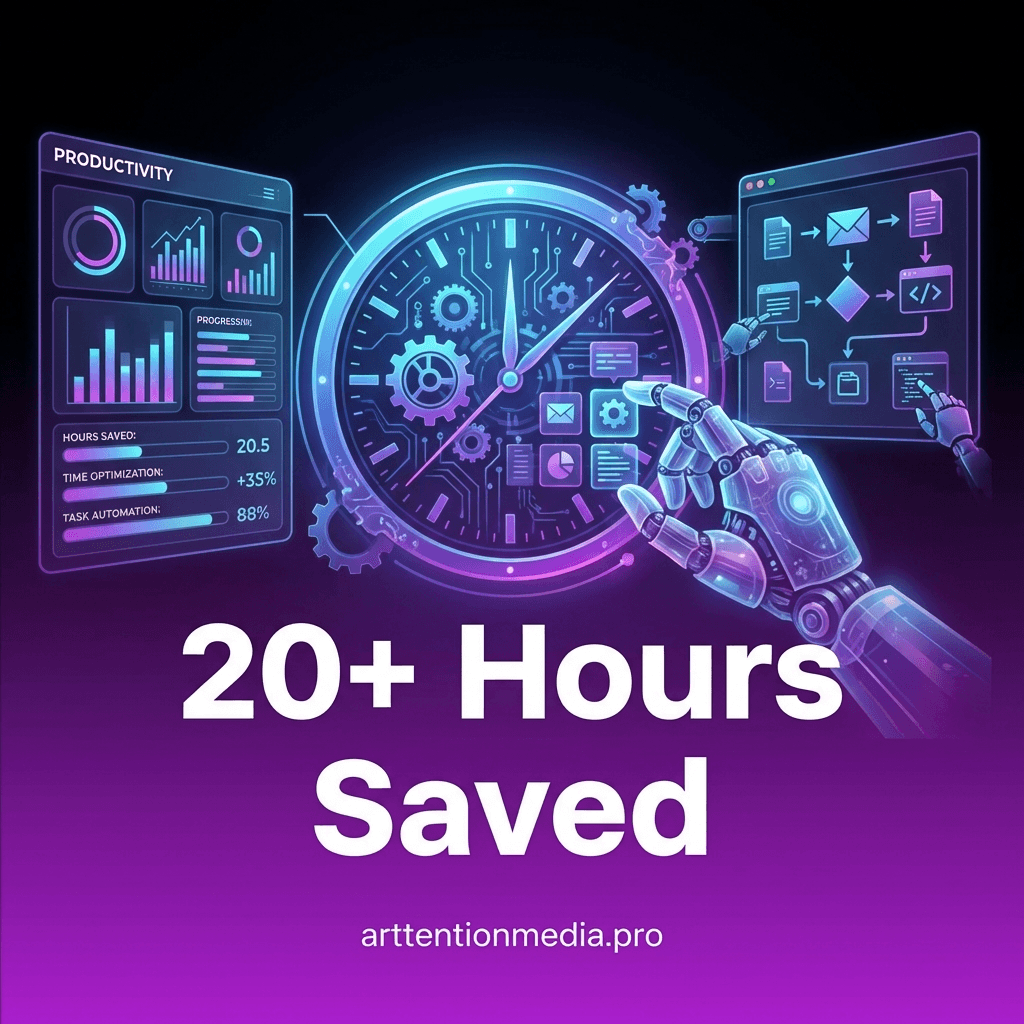

Small business owners typically work twice as hard as their employees, managing everything from customer service to marketing to operations. But a growing number are discovering something that changes everything: AI can handle the repetitive tasks that consume entire workdays, freeing up time for strategy, growth, and actually running the business instead of just surviving it.
We analyzed time savings across dozens of small business AI implementations and found consistent patterns. The businesses that embrace AI automation strategically are reclaiming an average of 20-30 hours per week—time previously spent on routine tasks that AI handles more efficiently and accurately than humans.
Where Small Businesses Lose Time (And How AI Reclaims It)
Most small business time drains follow predictable patterns. Understanding these patterns is the key to implementing AI solutions that deliver maximum time savings with minimal disruption to existing operations.
Customer Communication and Support
The average small business owner spends 6-8 hours weekly answering the same questions repeatedly: business hours, pricing, availability, basic product information, and simple troubleshooting. These interactions are valuable but don't require human creativity or complex decision-making.
AI customer service agents handle these routine inquiries instantly, providing accurate information while escalating complex issues to humans. The time saved isn't just the hours spent answering questions—it's the cognitive overhead of constant interruption and context switching.
- Automated response to frequently asked questions
- Intelligent routing of complex inquiries to appropriate team members
- 24/7 availability without overtime costs
- Consistent information delivery across all customer interactions
- Automatic follow-up on unresolved issues
Administrative Tasks and Data Entry
Small businesses often lack dedicated administrative staff, forcing owners and key employees to handle invoicing, inventory tracking, appointment scheduling, and customer data management. These tasks are necessary but time-intensive.
AI automation systems can process invoices, update inventory systems, schedule appointments, and maintain customer records with higher accuracy and speed than manual processes. The cumulative time savings from eliminating routine data entry often exceeds 10 hours per week for typical small businesses.
Marketing and Content Creation
Consistent marketing requires regular content creation, social media posting, email campaigns, and customer outreach. Many small business owners struggle to maintain marketing momentum while managing daily operations.
AI marketing agents can generate content calendars, create social media posts, design marketing materials, and execute email campaigns based on customer behavior and business goals. This doesn't replace strategic marketing thinking—it eliminates the time-consuming execution tasks that prevent consistent marketing efforts.
The Compound Effect of AI Time Savings
The real value of AI time savings extends beyond simple hour calculations. When business owners reclaim significant time from routine tasks, they can focus on activities that actually grow the business—strategy development, relationship building, product innovation, and market expansion.
Strategic Thinking Time
Most small business owners are too busy working in their business to work on their business. AI automation creates space for strategic thinking, market analysis, and long-term planning—activities that directly impact growth and profitability but often get postponed due to operational demands.
When routine tasks are automated, owners can spend time analyzing customer data, identifying growth opportunities, developing new services, and building strategic partnerships. This shift from tactical to strategic work often drives revenue growth that far exceeds AI implementation costs.
Improved Work-Life Balance
Small business ownership often means working evenings and weekends to keep up with operational demands. AI automation that handles routine tasks outside business hours—like customer inquiries, appointment reminders, and follow-up communications—allows owners to disconnect without losing business opportunities.
Better work-life balance isn't just about personal well-being. Rested, focused business owners make better decisions, maintain higher energy levels, and sustain long-term business growth more effectively than those constantly overwhelmed by operational tasks.
Implementation Strategies for Maximum Time Savings
Not all AI implementations deliver equal time savings. The most effective approaches target high-frequency, low-complexity tasks first, then gradually expand to more sophisticated automation as teams adapt to AI-enhanced workflows.
Start with Customer-Facing Automation
Customer service automation typically delivers the fastest and most noticeable time savings. Implementing AI chatbots or phone agents to handle routine inquiries provides immediate relief from constant interruptions while improving customer experience through instant responses.
The key is starting with clearly defined scenarios—frequently asked questions, appointment booking, basic product information—and expanding capabilities based on actual usage patterns and customer needs.
Automate Repetitive Back-Office Tasks
Back-office automation often provides larger cumulative time savings but requires more careful implementation. Tasks like invoice processing, inventory management, and customer data updates benefit from AI automation but need proper integration with existing business systems.
Successful back-office automation starts with data cleanup and process standardization. AI systems work best with clean, consistent data and clearly defined workflows. Investing time in preparation pays dividends in automation effectiveness.
Marketing Automation with Business Context
AI marketing automation saves significant time when it understands business goals, customer segments, and brand voice. Generic marketing automation provides limited value, but AI systems trained on specific business data and objectives can create targeted, effective marketing campaigns automatically.
The most effective marketing automation integrates with customer data, sales systems, and business calendars to create contextually relevant campaigns that adapt to business cycles and customer behavior patterns.
Measuring and Optimizing Time Savings
Tracking AI-generated time savings helps justify implementation costs and identify opportunities for further optimization. However, measuring time savings requires looking beyond simple task completion times to understand broader productivity impacts.
Direct Time Measurements
- Hours previously spent on now-automated tasks
- Reduction in time-to-completion for routine processes
- Decreased response times for customer inquiries
- Eliminated overtime hours for administrative work
- Reduced time spent on error correction and rework
Productivity and Quality Improvements
AI automation often improves work quality while saving time. Automated systems don't make transcription errors, forget follow-up tasks, or provide inconsistent information. These quality improvements reduce time spent fixing mistakes and managing customer complaints.
Additionally, AI systems can work outside business hours, effectively extending operational capacity without requiring additional staff. This availability often generates new business opportunities and improves customer satisfaction.
Strategic Time Allocation
The ultimate measure of AI time savings is how that reclaimed time gets utilized. Businesses that redirect saved time toward growth activities—market research, product development, strategic planning, relationship building—typically see revenue increases that far exceed automation costs.
Common Implementation Pitfalls and How to Avoid Them
While AI automation offers significant time savings potential, unsuccessful implementations can actually increase workload and create new problems. Understanding common pitfalls helps ensure AI delivers promised benefits.
Over-Automation Too Quickly
Attempting to automate too many processes simultaneously often creates confusion and resistance among team members. Successful implementations start with one or two high-impact processes, ensure they work smoothly, then gradually expand automation scope.
This gradual approach allows teams to adapt to AI-enhanced workflows and provides opportunities to refine automation before scaling to additional processes.
Inadequate Training and Change Management
AI systems require human oversight and occasional intervention. Team members need training on how to work with AI tools, when to trust automated decisions, and how to handle edge cases that require human judgment.
Effective change management includes clear communication about AI's role, training on new workflows, and feedback mechanisms for continuous improvement. Teams that understand and trust AI systems achieve better results than those that feel replaced or threatened by automation.
Neglecting Data Quality and System Integration
AI automation is only as good as the data and systems it works with. Poor data quality leads to incorrect automated decisions, while inadequate system integration creates manual workarounds that eliminate time savings.
Successful implementations invest in data cleanup, establish clear data governance, and ensure AI systems integrate smoothly with existing business tools and workflows.
Industry-Specific Time-Saving Opportunities
While the principles of AI time savings apply broadly, specific industries have unique opportunities for automation that deliver exceptional results when implemented thoughtfully.
Professional Services
Law firms, accounting practices, consulting agencies, and similar businesses spend significant time on client communication, document management, and project coordination. AI automation can handle appointment scheduling, document review, time tracking, and client updates, freeing professionals to focus on high-value advisory work.
Retail and E-commerce
Retail businesses benefit from AI automation of inventory management, customer service, order processing, and personalized marketing. These businesses often see dramatic time savings in customer support and inventory reconciliation—tasks that previously required constant attention.
Healthcare and Wellness
Healthcare practices, fitness studios, and wellness centers can automate appointment scheduling, patient intake, insurance verification, and follow-up communications. This automation reduces administrative burden and improves patient experience through faster, more consistent service.
Building Long-Term AI Strategy for Sustained Time Savings
The businesses achieving the greatest time savings from AI think beyond individual tool implementations to comprehensive automation strategies that evolve with business growth and technological advancement.
Scalable Automation Infrastructure
Effective AI implementations use platforms and approaches that can grow with the business. This means choosing AI solutions that integrate with multiple business systems, support increasing complexity, and can adapt to changing business needs without requiring complete re-implementation.
Continuous Learning and Optimization
The most successful small businesses treat AI implementation as an ongoing optimization process rather than a one-time project. They regularly analyze automation performance, identify new opportunities for time savings, and refine AI systems based on real usage data and business outcomes.
Team Development and AI Literacy
Long-term success requires building team capabilities around AI tools and automation. This includes training existing staff to work effectively with AI systems and hiring team members who can leverage automation to achieve better business outcomes.
The Competitive Advantage of Reclaimed Time
Small businesses that successfully implement AI automation gain more than operational efficiency—they gain competitive advantages through faster response times, improved service quality, and the ability to focus human talent on growth and innovation rather than routine tasks.
In competitive markets, the businesses that can operate more efficiently while maintaining high service quality have sustainable advantages. AI automation enables small businesses to compete with larger companies on service quality and operational efficiency without requiring proportional increases in staff or overhead.
The question isn't whether AI will eventually automate routine business tasks. It's whether your business will lead this transformation or be forced to catch up later when competitors have already captured the advantages of efficient, AI-enhanced operations.
Frequently Asked Questions
How long does it take to see measurable time savings from AI automation?
Most businesses see immediate time savings from customer service automation within days of implementation. More complex back-office automation typically shows measurable results within 2-4 weeks as teams adapt to new workflows and AI systems learn business patterns.
What types of small businesses benefit most from AI time-saving automation?
Any business with routine customer interactions, administrative tasks, or repetitive processes benefits from AI automation. Service businesses, retail operations, professional practices, and businesses with high customer communication volumes typically see the largest time savings.
How much does it cost to implement time-saving AI automation?
Costs vary based on complexity and integration requirements. Basic automation can start affordably and scale based on results. Most businesses find that time savings justify costs within the first few months of implementation.
Will AI automation eliminate the need for human employees?
AI automation typically shifts human work from routine tasks to higher-value activities rather than eliminating jobs. Most small businesses use AI to handle growth without proportional staff increases, enabling existing teams to focus on customer relationships and business development.
How do I choose which tasks to automate first?
Start with high-frequency, low-complexity tasks that don't require creative problem-solving. Customer FAQ responses, appointment scheduling, and basic data entry are typically good starting points. Focus on tasks that interrupt important work or consume significant time weekly.
Take it further with Arttention Media
Explore the services behind the ideas in this article:
Mathew Munyao
Founder, Arttention Media
Mathew is the founder of Arttention Media, an AI-powered digital agency serving businesses globally. With 6+ years in digital marketing and AI, he leads a team that has deployed dozens of websites, generated hundreds of qualified leads for clients worldwide, and built custom AI agents for businesses across multiple continents.
Ready to grow your business?
Book a free consultation — no pressure, just honest advice about what will work for your industry.
Book a Free Consultation →