The Cost of NOT Using AI: What Inaction Really Costs Your Business
Mathew Munyao
Founder, Arttention Media
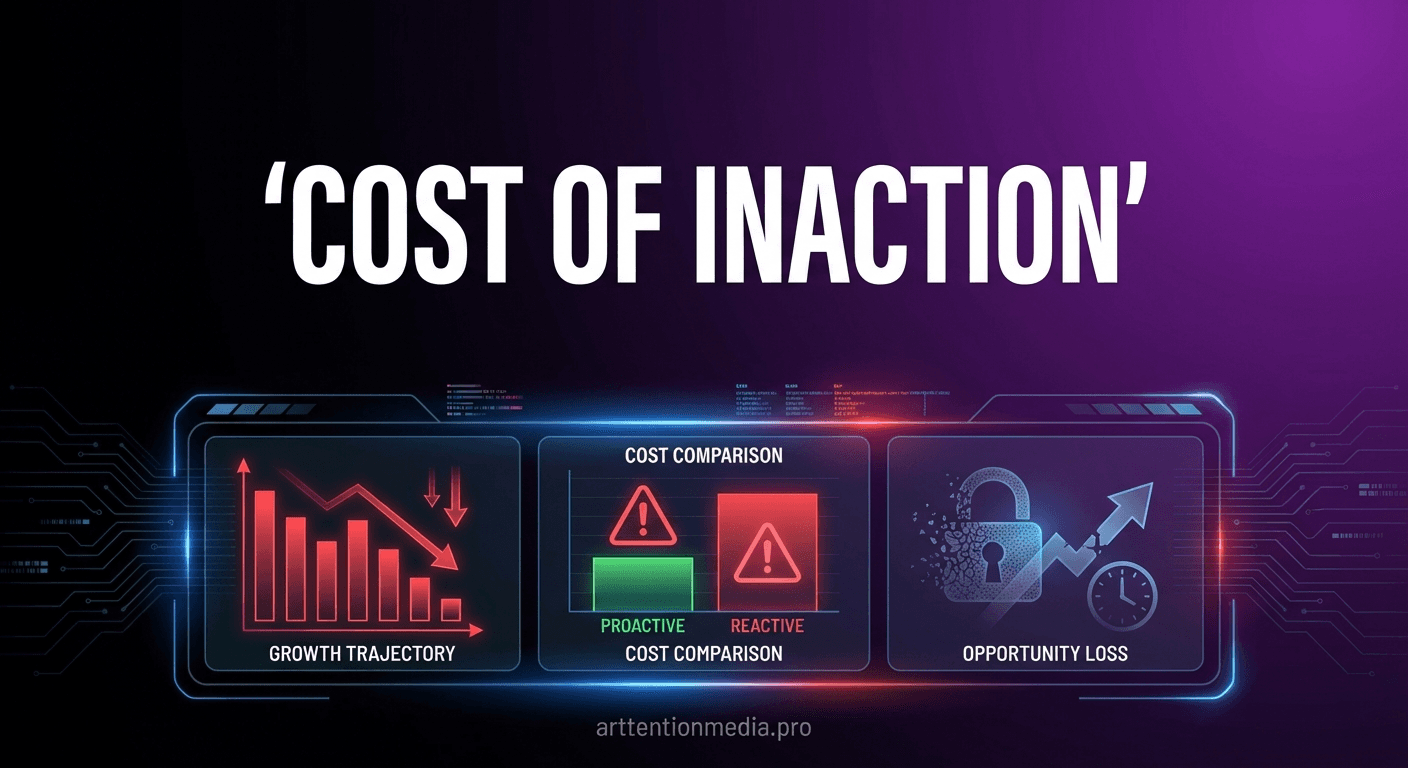

While businesses debate whether they're ready for AI, their competitors are already using it to serve customers faster, operate more efficiently, and scale without massive overhead increases. The question isn't whether you can afford to implement AI — it's whether you can afford not to.
The hidden costs of avoiding AI automation compound daily. Every missed call, delayed response, manual task, and operational bottleneck represents lost revenue and competitive disadvantage that grows larger with time. Here's the real cost of inaction and why waiting is more expensive than implementing.
The Response Time Gap Is Widening
Customer expectations for response times have accelerated dramatically. Studies show that 82% of consumers expect immediate responses to sales and support questions. Businesses still relying on human-only customer service are falling further behind these expectations every month.
Companies using AI customer service respond to inquiries within seconds, 24/7. Their human competitors take hours or days, and only during business hours. This gap isn't just about customer satisfaction — it directly impacts conversion rates and sales.
When a potential customer submits an inquiry, they often contact multiple businesses. The first company to respond professionally gets the sale. Businesses without AI response systems are systematically losing prospects to faster competitors, often without realizing it.
Manual Labor Costs Are Accelerating
Labor costs continue rising while AI automation costs continue falling. This creates an expanding cost gap that makes manual processes increasingly expensive relative to automated alternatives.
Consider a typical small business spending 20 hours per week on tasks that could be automated: appointment scheduling, customer support, data entry, and follow-up communications. At current labor rates, that's substantial monthly costs that recur forever. AI automation handles these same tasks for a fraction of the cost.
The cost comparison gets worse over time. Human labor costs increase annually while AI automation costs decrease as technology improves and becomes more accessible. Businesses that delay automation are choosing the more expensive path permanently.
Capacity Constraints Kill Growth
Manual processes create hard limits on business growth. You can only handle as many customers as your staff has time to serve. Growing beyond current capacity requires hiring, training, and managing additional employees — expensive and time-consuming processes.
Businesses with AI automation can scale customer service, sales processes, and operational tasks instantly. They handle 10x more customer inquiries without 10x more staff. They can enter new markets, launch new services, or handle seasonal spikes without workforce planning delays.
While manual businesses plan hiring to meet growing demand, automated businesses capture that demand immediately. The difference in growth rates compounds over time, creating unbridgeable competitive gaps.
Human Error Costs More Than AI Implementation
Manual processes are inconsistent and error-prone. Staff forget procedures, make data entry mistakes, miss follow-up appointments, and interpret policies differently. These errors cost money through rework, customer dissatisfaction, and lost opportunities.
AI systems perform tasks consistently every time. They don't forget procedures, skip steps, or have bad days. The reduction in errors alone often justifies automation costs, even before considering speed and capacity benefits.
- Missed appointments due to scheduling errors
- Lost leads from delayed or forgotten follow-up
- Customer complaints from inconsistent service
- Billing errors from manual data entry
- Compliance issues from process variations
- Inventory mistakes from manual tracking
- Pricing errors in quotes and proposals
These problems become more expensive as businesses grow. More staff means more potential for errors. More customers means larger impact from each mistake. AI automation prevents these costs from scaling with business size.
The Opportunity Cost of Staff Time
Your staff spend significant time on routine tasks that AI could handle automatically. This isn't just about the cost of their time — it's about what they can't do while handling routine work.
When your best salesperson spends 30% of their time on data entry and appointment scheduling, they can't spend that time on strategic sales activities. When customer service staff answer the same basic questions repeatedly, they can't focus on complex problem-solving and relationship building.
AI automation frees skilled staff to work on high-value activities that actually require human creativity, judgment, and expertise. The productivity gain from this reallocation often exceeds the direct cost savings from automation.
Customer Service Expectations Are Permanent
Once customers experience AI-powered service — instant responses, 24/7 availability, consistent quality — they expect it everywhere. Businesses that don't meet these expectations are seen as outdated and unprofessional.
This shift in customer expectations is permanent and accelerating. Younger customers especially expect digital-first experiences with immediate response times. Businesses serving these customers without AI automation are fighting an unwinnable battle against rising expectations.
The customer service bar continues rising as more businesses deploy AI systems. What seemed like excellent service last year may feel slow and unreliable compared to AI-powered alternatives customers encounter elsewhere.
Data and Insights Lost Forever
Manual processes generate little usable data about customer behavior, operational efficiency, or business performance. You can't optimize what you can't measure, and manual tracking is too expensive and inconsistent to provide reliable insights.
AI systems automatically capture detailed data about every customer interaction, process performance, and operational bottleneck. This data enables continuous optimization that improves business performance over time.
Businesses without automated data collection are making decisions based on intuition and incomplete information while their AI-enabled competitors optimize based on complete performance data. This informational disadvantage compounds over time.
The Implementation Delay Penalty
AI automation provides benefits from day one, but the full value builds over time as systems learn and optimize. Every month you delay implementation is a month of benefits lost forever.
Early AI adopters also benefit from learning curves and competitive positioning. They understand how to work with AI systems effectively, which processes to automate first, and how to train staff for human-AI collaboration. Later adopters must catch up on both technology and organizational learning.
The businesses that implement AI automation this year will be substantially ahead of those that wait until next year, not just in technology but in operational efficiency, customer satisfaction, and market positioning.
Competitive Displacement Risk
Industries are being reshaped by AI adoption. Early adopters capture market share from slower competitors through superior service, lower costs, and faster growth capabilities.
This isn't a gradual process. Once AI-enabled competitors establish superior service levels and cost structures, they can rapidly gain market share. Traditional competitors find it difficult to respond quickly enough because implementing AI systems takes time.
The risk isn't just lost revenue — it's business model obsolescence. Companies that build AI-powered operations can serve customers at price points and service levels that manual processes cannot match.
We waited two years to implement AI automation because we thought it was too complex and expensive. Our biggest competitor implemented it 18 months ago and has captured 40% market share with faster service and lower prices.
The Real ROI of Immediate Action
When businesses calculate AI automation ROI, they typically focus on cost savings from reduced labor. The real benefits are much larger: increased capacity, improved customer satisfaction, competitive advantages, better data insights, and freed staff time for high-value activities.
These benefits compound over time. A business that implements AI automation today doesn't just save costs — it builds capabilities that enable faster growth, better service, and stronger competitive positioning for years.
The payback period for AI automation is typically 6-12 months based on direct cost savings alone. When you include capacity expansion, competitive advantages, and growth acceleration, the ROI is substantially higher.
Starting Points That Minimize Risk
Businesses worried about AI implementation complexity can start with low-risk, high-impact applications. Customer service chatbots, appointment scheduling automation, and lead response systems provide immediate value with minimal downside risk.
These implementations also build organizational AI expertise and confidence. Staff learn to work with AI systems, management understands the benefits, and everyone sees what's possible. This experience makes expanding AI automation easier and more successful.
The businesses that start small and learn fast are positioning themselves to scale AI automation across their operations. Those that wait for perfect solutions miss opportunities to build capabilities while competitors pull ahead.
FAQ
How do we calculate what inaction is costing our business?
Track missed opportunities: leads that don't respond due to slow follow-up, customers who choose competitors with faster service, staff time spent on automatable tasks, and errors that create rework. Multiply these by their frequency and financial impact.
What if AI automation doesn't work for our industry?
AI automation is being successfully implemented across virtually every industry. The specific applications vary, but the core benefits — faster response times, consistent processes, and increased capacity — apply universally to businesses serving customers.
How can we justify AI implementation costs to stakeholders?
Present both the cost of implementation and the cost of inaction. Include lost revenue from slow responses, staff time costs for manual processes, and competitive risks. Show how delaying implementation makes the problem more expensive to solve.
What if our competitors aren't using AI yet?
That's an opportunity, not a reason to wait. Being first in your market to offer AI-powered service creates significant competitive advantages. Your competitors will implement AI eventually — better to be ahead than behind.
How quickly can we see results from AI automation?
Most businesses see immediate improvements in response times and capacity once AI systems are deployed. Full ROI typically becomes clear within 6-12 months as the systems optimize and staff adapt to working with AI automation.
Take it further with Arttention Media
Explore the services behind the ideas in this article:
Mathew Munyao
Founder, Arttention Media
Mathew is the founder of Arttention Media, an AI-powered digital agency serving businesses globally. With 6+ years in digital marketing and AI, he leads a team that has deployed dozens of websites, generated hundreds of qualified leads for clients worldwide, and built custom AI agents for businesses across multiple continents.
Ready to grow your business?
Book a free consultation — no pressure, just honest advice about what will work for your industry.
Book a Free Consultation →