The Future of Work in 2026: How AI Transforms Collaboration
Mathew Munyao
Founder, Arttention Media
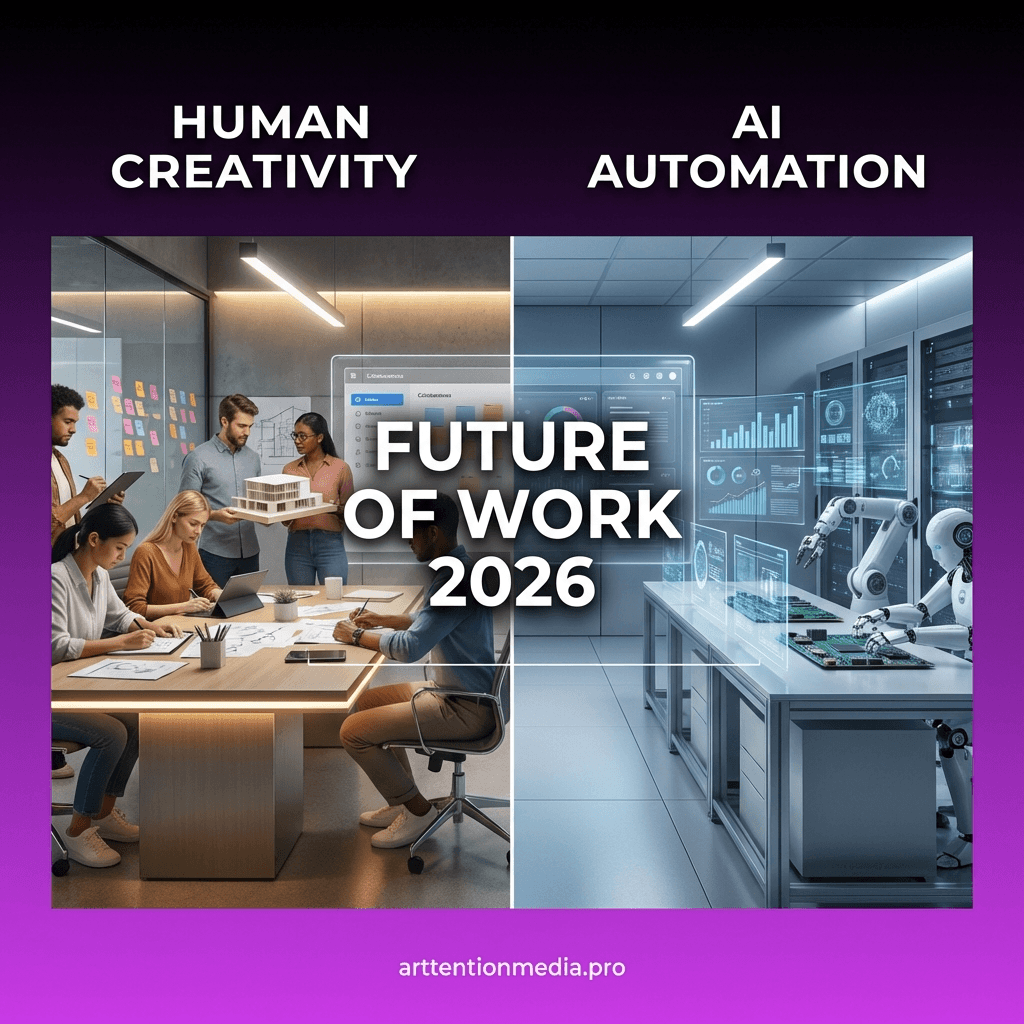
The future of work isn't about AI replacing humans—it's about AI transforming how humans work. By 2026, the most successful professionals aren't those who compete with AI, but those who collaborate with it effectively. This collaboration is already reshaping industries, redefining job roles, and creating new forms of productivity that neither humans nor AI could achieve alone.
The transformation is happening faster than most organizations anticipated. AI agents are becoming team members, not just tools. They're taking on complex responsibilities, learning from human expertise, and contributing to creative and strategic decisions. Understanding how to work effectively with AI is quickly becoming the most valuable skill in the modern workplace.
The New Human-AI Collaboration Model
Traditional automation replaced human tasks with machines. AI collaboration creates hybrid workflows where humans and AI systems work together on shared objectives, each contributing their unique strengths to achieve better outcomes than either could accomplish independently.
Complementary Strengths in Practice
Humans excel at creative problem-solving, emotional intelligence, strategic thinking, and adapting to unexpected situations. AI systems excel at data processing, pattern recognition, consistency, and handling repetitive tasks at scale.
The most effective human-AI collaboration leverages these complementary strengths. AI handles data analysis and routine execution while humans provide context, make strategic decisions, and manage complex interpersonal relationships.
From Task Automation to Workflow Integration
Early AI adoption focused on automating specific tasks—data entry, scheduling, simple customer service responses. Modern AI integration involves AI systems that understand business context, learn from human feedback, and participate in complex, multi-step workflows.
These integrated AI systems don't just execute predefined tasks. They adapt to changing conditions, suggest improvements to existing processes, and even identify opportunities that humans might miss.
Transformation Across Industries
AI collaboration is transforming work across every industry, though the specific changes vary based on industry characteristics and existing work patterns.
Professional Services Revolution
Law firms, consulting agencies, accounting practices, and similar businesses are using AI agents to handle research, document analysis, preliminary client communications, and routine advisory tasks.
This allows human professionals to focus on high-value activities—strategic advice, complex problem-solving, client relationship management, and creative solutions that require human insight and experience.
- AI agents conduct comprehensive legal research and case law analysis
- Automated document review and contract analysis with human oversight
- AI-powered financial modeling with human strategy and interpretation
- Intelligent client intake and preliminary consultation automation
- Real-time market research and competitive intelligence gathering
Healthcare and Medical Practice
Healthcare professionals work with AI systems that analyze medical images, monitor patient data, suggest treatment options, and manage administrative tasks, allowing doctors and nurses to spend more time on direct patient care.
AI doesn't replace medical judgment—it enhances it by providing comprehensive data analysis, identifying potential issues early, and ensuring that healthcare providers have complete information for decision-making.
Creative Industries Transformation
Designers, writers, marketers, and other creative professionals use AI as collaborative partners that generate initial concepts, provide research and reference materials, and handle technical execution while humans provide vision, strategy, and creative direction.
This collaboration enables creative professionals to explore more ideas, iterate faster, and focus on high-level creative strategy rather than technical execution.
Skills for the AI-Integrated Workplace
Success in AI-integrated workplaces requires developing new skills that focus on effective human-AI collaboration rather than competing with AI capabilities.
AI Literacy and Prompt Engineering
Understanding how to communicate effectively with AI systems—providing clear instructions, proper context, and useful feedback—becomes as important as traditional communication skills.
Effective prompt engineering involves understanding AI strengths and limitations, structuring requests for optimal results, and iterating based on AI responses to achieve desired outcomes.
Strategic Thinking and Context Setting
While AI excels at execution and analysis, humans remain essential for setting strategic direction, providing business context, and making decisions that require understanding of organizational goals and market dynamics.
Professionals who excel at strategic thinking—understanding why certain approaches work, anticipating market changes, and aligning AI capabilities with business objectives—become increasingly valuable.
Quality Control and AI Output Evaluation
AI systems require human oversight to ensure quality, accuracy, and appropriateness of outputs. Developing skills to quickly evaluate AI-generated work, identify potential issues, and provide corrective feedback becomes crucial.
This includes understanding common AI failure modes, recognizing when AI outputs need human review, and knowing how to refine AI-generated work to meet professional standards.
Organizational Changes and Management
Organizations must adapt their structures, processes, and cultures to support effective human-AI collaboration.
New Roles and Responsibilities
Organizations are creating new roles focused on human-AI collaboration—AI trainers who help AI systems learn organizational processes, AI coordinators who manage human-AI workflows, and AI strategists who identify opportunities for AI integration.
Traditional roles are evolving to include AI collaboration responsibilities. Project managers now coordinate both human team members and AI agents. Analysts work with AI systems to process larger datasets and generate deeper insights.
Workflow and Process Redesign
Effective AI integration often requires redesigning workflows to optimize human-AI collaboration. This might involve restructuring tasks, creating new quality control processes, and establishing clear handoff points between human and AI work.
Organizations must also develop policies around AI usage, data privacy, quality standards, and decision-making authority that ensure AI integration supports rather than disrupts business objectives.
Training and Change Management
Successful AI integration requires comprehensive training programs that help employees understand AI capabilities, learn collaboration techniques, and adapt to new workflows.
Change management becomes crucial as AI integration affects job roles, team dynamics, and organizational culture. Clear communication about AI's role and ongoing support for adaptation help ensure successful transformation.
Productivity and Performance Improvements
Organizations implementing effective human-AI collaboration see significant improvements in productivity, quality, and innovation capabilities.
Speed and Scale Advantages
AI collaboration enables professionals to handle larger volumes of work, process information faster, and execute complex tasks with greater consistency. This scaling effect allows organizations to take on larger projects or serve more customers without proportional increases in staff.
The speed improvements are particularly notable in knowledge work—research, analysis, content creation, and document processing—where AI can accelerate information gathering and initial processing while humans focus on interpretation and strategy.
Quality and Consistency Improvements
AI systems provide consistent performance and can help humans avoid errors, particularly in routine or repetitive tasks. Human oversight ensures quality while AI handles the detail work that can lead to mistakes when done manually.
This combination often produces higher quality outcomes than either humans or AI could achieve independently—AI provides consistency and thoroughness while humans provide judgment and refinement.
Innovation and Creative Expansion
AI collaboration enables professionals to explore more ideas, test more approaches, and iterate faster. This expansion of creative capacity often leads to breakthrough solutions and innovations that wouldn't have been possible within traditional time and resource constraints.
Challenges and Solutions in AI Collaboration
While AI collaboration offers significant benefits, organizations face challenges that must be addressed thoughtfully for successful implementation.
Trust and Reliability Issues
Building trust in AI systems requires demonstrating reliability over time, providing transparency in AI decision-making, and establishing clear protocols for when human override is necessary.
Successful implementations start with low-risk applications where AI errors won't cause significant problems, gradually expanding to more critical applications as trust and reliability are established.
Integration Complexity
Integrating AI systems with existing workflows, tools, and processes can be technically challenging. Organizations need clear integration strategies, proper technical resources, and realistic timelines for AI adoption.
Phased implementation approaches that start with pilot programs and expand gradually tend to be more successful than attempting comprehensive AI integration all at once.
Employee Adaptation and Resistance
Some employees may resist AI integration due to job security concerns or discomfort with new technology. Clear communication about AI's role, comprehensive training programs, and demonstrating AI as an enhancement rather than replacement helps address these concerns.
Involving employees in AI implementation planning and providing opportunities to shape how AI is used in their work helps build buy-in and ensures AI integration supports rather than disrupts effective work patterns.
The Competitive Advantage of AI Collaboration
Organizations that master human-AI collaboration gain significant competitive advantages in speed, quality, innovation capability, and operational efficiency.
First-Mover Advantages
Early adopters of AI collaboration are developing capabilities, processes, and expertise that create sustainable competitive advantages. They're building AI-enhanced capabilities while competitors are still debating whether and how to adopt AI.
These early movers are also attracting talent who want to work with cutting-edge technology and develop AI collaboration skills that will be valuable throughout their careers.
Market Responsiveness
AI-integrated organizations can respond faster to market changes, customer needs, and competitive pressures. The speed and analytical advantages of AI collaboration enable rapid strategy adjustment and execution.
Talent Attraction and Retention
Professionals increasingly want to work for organizations that provide access to advanced AI tools and collaboration opportunities. Companies that invest in AI collaboration attract better talent and retain employees who might otherwise leave for more technologically advanced competitors.
Preparing for Continued Evolution
AI technology continues advancing rapidly, which means human-AI collaboration will continue evolving. Organizations must build adaptable approaches that can incorporate new AI capabilities as they emerge.
Building Flexible AI Strategies
Rather than committing to specific AI technologies or approaches, successful organizations focus on building capabilities for effective AI collaboration that can adapt to new AI developments.
This includes training employees in general AI collaboration principles, creating flexible workflows that can incorporate new AI capabilities, and maintaining awareness of emerging AI technologies that might benefit the organization.
Continuous Learning and Adaptation
AI collaboration requires ongoing learning and adaptation as both AI capabilities and human skills evolve. Organizations must create cultures of continuous learning that embrace change and encourage experimentation with new AI tools and techniques.
The Future Workplace Reality
The future of work isn't about humans versus AI—it's about humans plus AI creating capabilities that neither could achieve alone. Organizations that embrace this collaborative model will have significant advantages in productivity, innovation, and market responsiveness.
The question isn't whether AI will transform the workplace—that transformation is already underway. The question is whether your organization will lead this transformation or struggle to catch up as AI-integrated competitors pull ahead.
The professionals and organizations that thrive in this new environment will be those who learn to collaborate effectively with AI, leveraging the unique strengths of both human and artificial intelligence to achieve extraordinary results.
Frequently Asked Questions
Will AI eventually replace human workers entirely?
While AI will automate many routine tasks, the most valuable work increasingly involves complex problem-solving, creativity, and interpersonal skills where human-AI collaboration provides better results than either humans or AI working alone.
How can employees prepare for AI integration in their workplace?
Focus on developing skills that complement AI—strategic thinking, creative problem-solving, emotional intelligence, and learning how to work effectively with AI systems. Understanding basic AI capabilities and limitations is also valuable.
What types of jobs are most likely to benefit from AI collaboration?
Knowledge work roles involving analysis, research, content creation, and decision-making benefit significantly from AI collaboration. Jobs requiring human interaction, creativity, and strategic thinking also benefit when routine tasks are handled by AI.
How long does it take to successfully integrate AI collaboration in an organization?
Implementation timelines vary based on organizational size and complexity. Simple AI tools can show benefits within weeks, while comprehensive AI integration may take months. The key is starting with pilot programs and expanding based on results.
What are the biggest risks of AI workplace integration?
Primary risks include over-reliance on AI without proper human oversight, inadequate training leading to poor AI utilization, and resistance to change that prevents successful adoption. Proper planning, training, and gradual implementation minimize these risks.
Take it further with Arttention Media
Explore the services behind the ideas in this article:
Mathew Munyao
Founder, Arttention Media
Mathew is the founder of Arttention Media, an AI-powered digital agency serving businesses globally. With 6+ years in digital marketing and AI, he leads a team that has deployed dozens of websites, generated hundreds of qualified leads for clients worldwide, and built custom AI agents for businesses across multiple continents.
Ready to grow your business?
Book a free consultation — no pressure, just honest advice about what will work for your industry.
Book a Free Consultation →