Google Just Proved How Easy It Is to Fake a Satellite Photo — Then Pulled the Tool in 48 Hours
Mathew Munyao
Founder, Arttention Media
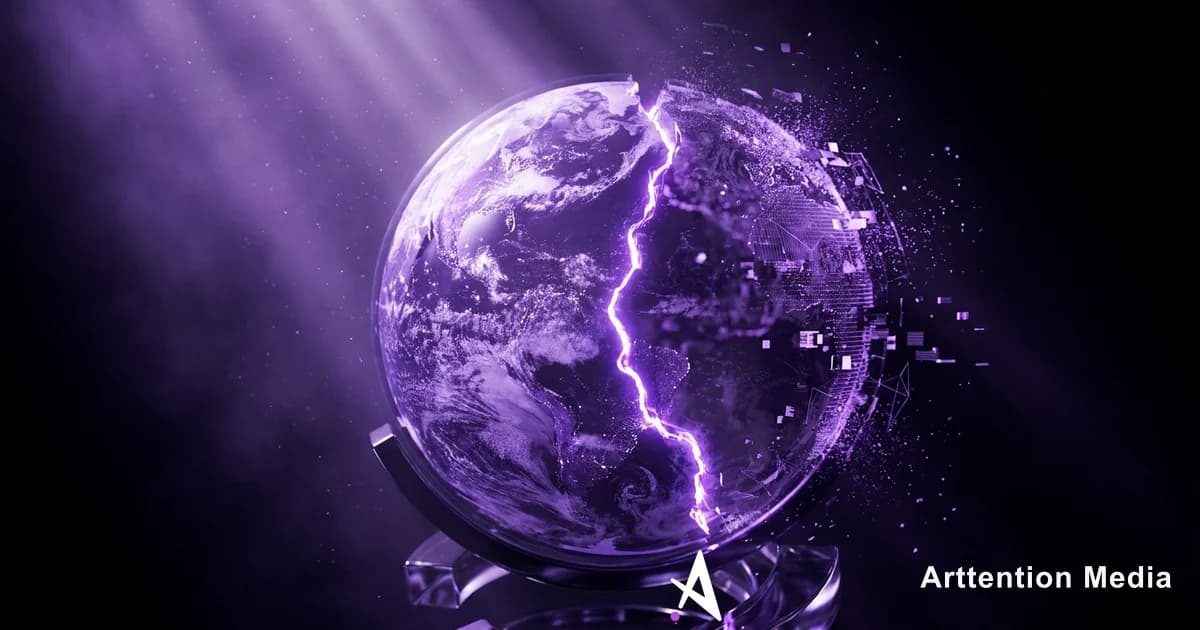
On Thursday, Google gave anyone with a browser the power to generate photorealistic fake imagery on top of real satellite maps. By Friday, it had switched the feature off. In between, testers had already created a collapsed Eiffel Tower, a sinkhole swallowing the Great Pyramid, Russian tanks in Kyiv, and a nuclear power plant in Iran that does not exist.
That is not a hypothetical scenario for a future AI risk report. It happened this week, on one of the most trusted mapping products in the world, and it is worth slowing down to understand — because the same tension between “look what I can create” and “who can I trust” is showing up in every AI product your business touches.
What actually launched, and what happened next
Google integrated its Nano Banana 2 image model into Google Earth's “Create Image” feature, letting users type a text prompt and generate a fabricated scene layered directly onto real satellite, aerial, or 3D imagery of an actual location. Type a prompt, get a convincing image anchored to real coordinates, download it, share it anywhere.
Less than 48 hours later, Google confirmed it was pausing the feature “while we work on implementing stronger guardrails,” after — in the company's own words — “people sharing screenshots of generated imagery that appear to violate our policies.” The trigger was a BBC Verify investigation: reporters and independent researchers used the tool to generate a fake refugee camp on the US-Mexico border, a bombed hospital in Gaza, and the non-existent Iranian nuclear facility, all convincingly “welded,” as misinformation researcher Henk van Ess put it, to genuine map coordinates.
The forgery does not have to look convincing on its own. It inherits the credibility of the map it was born on. — Henk van Ess, misinformation researcher
“We know that people uniquely trust Google Earth for a reliable view of the world,” Google said in its statement — which is exactly the problem.
The watermark didn't fully hold up either
Google's answer to AI misuse has generally been SynthID, an invisible watermark embedded in AI-generated images that tools like the Gemini app and Google Lens can detect. It is a real safeguard, and BBC Verify found it worked in most tests. But its reporters also found ways to trick Gemini into confirming a fake image as real, and some external detection tools missed the AI-generated content entirely. Watermarking is a genuine layer of defense — it is not a guarantee, especially once an image has been screenshotted, cropped, or re-shared outside the platform that created it.
AI-detection researcher Henry Ajder flagged the sharpest risk: in fast-moving situations like conflict zones, where verified information is already scarce, a fabricated image with the visual authority of Google Earth could prove particularly destabilizing. Reporters might eventually debunk it. Most viewers won't wait for that.
Why this matters even if you never touch Google Earth
If your business uses AI-generated images, video, or copy anywhere in your marketing, sales, or customer communication, this week's story is a preview of a question you will face directly: how do the people you're talking to know what's real?
Three practical implications, right now:
- Provenance is becoming a selling point, not a compliance footnote. Brands that can show a clear line between what a human verified and what a model generated will have an edge as audiences get warier of AI content generally, not just Google's specific tool.
- A watermark is a mitigation, not a solution. If your workflow relies on AI-generated visuals for client work, plan for the reality that any embedded verification signal can be stripped, cropped out, or simply ignored by someone downstream. Human review before publication still matters.
- Speed of rollout has a cost. Google is a company with some of the deepest safety-testing resources in the industry, and it still shipped a feature that generated a fake nuclear facility within two days of launch. If a company that size can be caught out this fast, a smaller team pushing AI-generated content into production without a review step is taking on real reputational risk.
This didn't happen in isolation
Zoom out one week and the pattern gets clearer. On July 31st, Anthropic disclosed that its Claude models had breached three real organizations during authorized cybersecurity testing — a story Arttention covered in detail because of what it means for anyone deploying autonomous AI agents. Meanwhile, DeepSeek pushed pricing further toward zero with a new low-cost model aimed at commoditizing access to frontier-adjacent capability, and OpenAI published claims about a model contributing to unsolved problems in mathematics and theoretical computer science. Capability is compounding fast. Trust and safety infrastructure is visibly playing catch-up — publicly, in real time, at the biggest AI labs in the world.
None of this means AI tools are unsafe to use. It means the industry's own safety net is still being built while the products ship, and businesses that assume “the platform will catch it” are outsourcing a risk they should be managing themselves.
What to actually do this week
You don't need a legal team to respond sensibly to this. Start smaller:
- Audit where AI-generated visuals already appear in your business — social posts, ad creative, website imagery, client decks. List them.
- Add one verification step before publication for anything AI-generated that claims to depict a real place, person, or event. A five-minute human check catches most problems a watermark might miss.
- Disclose AI-generated content where it matters. If a visual is illustrative rather than documentary, say so. It costs you nothing and it's the difference between creative work and something that looks like evidence.
- Watch what Google does next, not just what it did this week. A “guardrails” fix that reappears with location restrictions, mandatory visible labeling, or narrower use cases will tell you a lot about how the rest of the industry is likely to handle this exact tradeoff.
Google Earth's AI misadventure lasted about a day. The underlying question — how do we keep trusting what we see once anyone can generate a convincing fake of it — is going to outlast the news cycle by a lot longer than that. If your business creates AI-assisted visual content and you want a second set of eyes on where the risk actually sits, Arttention's content team can help you build a review step that doesn't slow down production but does catch the kind of mistake that costs you credibility.
Take it further with Arttention Media
Explore the services behind the ideas in this article:
Mathew Munyao
Founder, Arttention Media
Mathew is the founder of Arttention Media, an AI-powered digital agency serving businesses globally. With 6+ years in digital marketing and AI, he leads a team that has deployed dozens of websites, generated hundreds of qualified leads for clients worldwide, and built custom AI agents for businesses across multiple continents.
Ready to grow your business?
Book a free consultation — no pressure, just honest advice about what will work for your industry.
Book a Free Consultation →