GPT vs Claude vs Gemini: Which AI Model Is Best for Business?
Mathew Munyao
Founder, Arttention Media
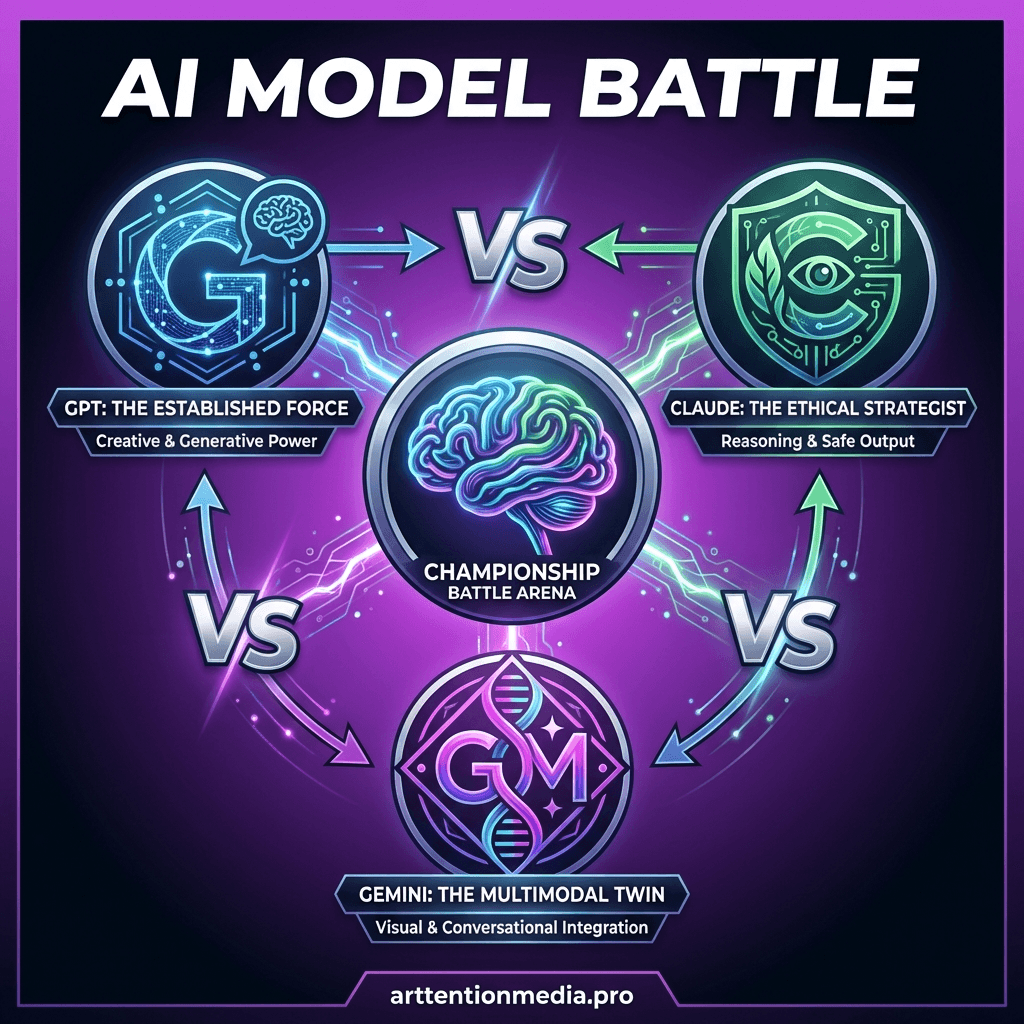
Choosing the right AI model for your business isn't just about capabilities—it's about matching AI strengths to specific business needs, team skills, and growth objectives. After deploying all three major AI models across dozens of business contexts, we've identified clear patterns in where GPT, Claude, and Gemini each excel.
The reality is that no single AI model dominates every use case. GPT excels in creative tasks and broad knowledge applications, Claude shines in analytical reasoning and safety-critical scenarios, while Gemini leads in multimodal capabilities and integration with Google services. Understanding these differences is crucial for making informed decisions about AI implementation.
Core Model Characteristics and Business Implications
Each AI model was designed with different priorities and training approaches, resulting in distinct strengths that map to different business applications. These fundamental differences affect everything from response style to integration complexity.
GPT: The Creative Generalist
OpenAI's GPT models, including GPT-4 and GPT-4o, were designed for broad applicability and creative capability. They excel at content generation, brainstorming, and tasks requiring creativity or broad world knowledge. The training approach emphasizes helpfulness and engagement, making GPT models particularly effective for customer-facing applications.
GPT's strengths become apparent in marketing content creation, customer service scenarios requiring empathy and creativity, and educational applications. The models handle ambiguous requests well and can adapt their communication style to different audiences effectively.
Claude: The Analytical Reasoner
Anthropic designed Claude with constitutional AI principles, emphasizing safety, reasoning, and analytical capability. Claude models excel in complex reasoning tasks, document analysis, and scenarios where accuracy and thoughtful analysis are paramount. The training approach prioritizes truthfulness and careful consideration of potential harms.
Claude's analytical strengths make it particularly valuable for business intelligence, risk assessment, policy analysis, and any application where careful reasoning and accuracy outweigh speed or creativity. The model is notably good at admitting uncertainty rather than generating plausible but incorrect information.
Gemini: The Multimodal Integrator
Google's Gemini was built with multimodal capabilities from the ground up, designed to understand and generate text, images, audio, and video within unified workflows. Gemini excels in applications requiring multiple input types and integrates naturally with Google's business ecosystem.
Gemini's multimodal strength makes it ideal for businesses already using Google Workspace, applications requiring image or document analysis, and workflows that benefit from seamless integration across different media types.
Business Use Case Analysis: Where Each Model Excels
Real-world business applications reveal significant differences in model performance across different types of tasks. Understanding these patterns helps businesses choose the right AI model for specific objectives.
Customer Service and Engagement
For customer-facing applications, model choice depends on the type of interactions your business needs to support.
**GPT** excels in creative customer service scenarios where empathy, personality, and adaptable communication styles improve customer experience. GPT models handle diverse customer personalities well and can adjust their tone and approach based on context. They're particularly effective for businesses where brand voice and customer engagement are priorities.
**Claude** works best for customer service requiring careful analysis of complex situations, policy interpretation, or scenarios where accuracy is more important than personality. Claude models excel when customers have complex technical issues or when service interactions involve potential liability or safety concerns.
**Gemini** is ideal when customer service involves visual elements—product identification, troubleshooting with images, or integration with Google services that customers already use. Gemini's multimodal capabilities enable richer support interactions that combine text, images, and documents.
Content Creation and Marketing
Marketing applications show distinct model preferences based on content type and business objectives.
**GPT** dominates creative marketing content—blog posts, social media content, advertising copy, and brand voice development. The models generate engaging, varied content that resonates with different audience segments. GPT is particularly effective for businesses that rely on content marketing and need high-volume, creative output.
**Claude** excels in analytical marketing content—market research analysis, competitive intelligence, data-driven insights, and strategic planning documents. When marketing decisions require careful analysis of complex data or potential risks, Claude's analytical capabilities provide more reliable insights.
**Gemini** leads in multimodal marketing applications—image analysis for visual branding, video content planning, integration with Google Ads and Analytics, and campaigns that span multiple media types. Businesses already using Google's marketing ecosystem see significant advantages with Gemini.
Business Intelligence and Analysis
Data analysis and business intelligence applications reveal clear model preferences based on analytical requirements.
**Claude** consistently outperforms in complex analytical tasks—financial analysis, risk assessment, policy review, and strategic planning. The model's careful reasoning approach and reluctance to make unsupported claims make it particularly valuable for high-stakes business decisions.
**GPT** handles broader business intelligence tasks well—trend identification, creative problem-solving, and scenario planning that benefits from creative thinking. GPT models excel when business intelligence requires connecting diverse information sources or generating innovative solutions.
**Gemini** excels when business intelligence involves multiple data types—analyzing charts and graphs, processing documents with visual elements, or integrating with Google Analytics and other Google business tools.
Technical Integration Considerations
Beyond capabilities, practical implementation factors significantly influence model choice for business applications.
API Design and Development Experience
**OpenAI's API** (GPT) offers mature, well-documented interfaces with extensive community support and third-party integrations. The API design prioritizes developer experience, with comprehensive documentation and robust error handling. However, rate limits and pricing can be challenging for high-volume applications.
**Anthropic's API** (Claude) provides clean, straightforward integration with excellent safety features and transparent usage policies. The API is particularly well-suited for applications requiring consistent, reliable behavior. Claude's context window capabilities excel for document analysis applications.
**Google's Gemini API** integrates seamlessly with Google Cloud Platform and Google Workspace, offering significant advantages for businesses already using Google's ecosystem. The multimodal capabilities require more complex integration but enable richer applications.
Scalability and Performance
- GPT models offer good scalability but can be expensive at high volume
- Claude provides excellent performance for analytical tasks with reasonable pricing
- Gemini scales well within Google's infrastructure but may require Google Cloud adoption
- All three models support real-time applications with proper implementation
- Response times vary based on model size and complexity of requests
Security and Compliance
**Claude** leads in safety and compliance features, with constitutional AI training that reduces harmful outputs and clear policies around data usage. This makes Claude particularly suitable for regulated industries or applications handling sensitive information.
**GPT** offers enterprise-grade security features through OpenAI's business plans, with options for private deployment and data handling controls. The security features are robust but require careful configuration.
**Gemini** benefits from Google's enterprise security infrastructure and compliance certifications, making it attractive for businesses that require specific compliance standards or already trust Google with business data.
Cost Analysis and ROI Considerations
Understanding the total cost of AI implementation requires considering not just API pricing, but development complexity, maintenance requirements, and business value delivered.
Pricing Model Comparison
**GPT pricing** is based on token usage with different rates for input and output tokens. Costs can scale quickly for high-volume applications, but the versatility often justifies the expense. Creative applications that benefit from GPT's capabilities typically achieve strong ROI despite higher per-token costs.
**Claude pricing** is generally competitive for analytical applications, with generous context windows that can reduce total costs for document-heavy applications. The accuracy and safety features often justify costs for business-critical applications.
**Gemini pricing** within Google's ecosystem can be highly competitive, especially for businesses already paying for Google Workspace or Cloud Platform services. The multimodal capabilities provide significant value when needed.
Development and Maintenance Costs
Total cost of ownership extends beyond API usage to include development time, integration complexity, and ongoing maintenance requirements.
**GPT implementations** benefit from extensive community resources and third-party tools, potentially reducing development time. However, managing creative outputs for consistency can require additional development effort.
**Claude implementations** often require less prompt engineering for analytical tasks, potentially reducing development and maintenance costs. The consistent behavior reduces ongoing tuning requirements.
**Gemini implementations** may require more initial setup for multimodal features but can reduce total infrastructure costs for businesses already using Google services.
Making the Right Choice for Your Business
The optimal AI model choice depends on your specific business requirements, existing technology stack, and growth objectives. Most businesses benefit from a decision framework that considers multiple factors rather than simply choosing the "best" model.
Decision Framework
Start by identifying your primary use case: Is creativity more important than accuracy? Do you need multimodal capabilities? Are you already invested in Google's ecosystem? Do you handle sensitive data requiring enhanced safety features?
Consider your team's technical capabilities: GPT offers the most community support and learning resources. Claude requires less prompt engineering for analytical tasks. Gemini may need Google Cloud expertise for optimal implementation.
Evaluate integration requirements: How will the AI model connect to your existing systems? Do you need real-time responses or batch processing? What data privacy and security requirements do you have?
Multi-Model Strategy
Many successful businesses don't choose a single AI model but instead use different models for different applications. This approach maximizes each model's strengths while avoiding vendor lock-in.
A typical multi-model approach might use GPT for customer-facing creative content, Claude for internal analysis and risk assessment, and Gemini for applications requiring multimodal capabilities or Google integration.
Future-Proofing Your Decision
AI models evolve rapidly, so choose implementation approaches that can adapt to new capabilities and model improvements. Focus on building AI workflows and infrastructure that can work with multiple models rather than optimizing for any single model's current capabilities.
Implementation Best Practices
Regardless of which model you choose, certain implementation practices maximize success across all AI platforms.
Start with Clear Objectives
Define specific business outcomes you want to achieve with AI before choosing a model. Clear objectives make it easier to evaluate model performance and justify implementation costs.
Design for Monitoring and Optimization
Implement monitoring systems to track AI performance, costs, and business impact from the beginning. This data enables continuous optimization and provides evidence for scaling AI initiatives.
Plan for Human Oversight
All AI models require human oversight for optimal performance. Design workflows that include appropriate human review, feedback mechanisms, and escalation procedures for edge cases.
The Competitive Landscape in 2026
The AI model landscape continues evolving rapidly, with each platform investing heavily in addressing current limitations. GPT is expanding multimodal capabilities, Claude is improving creative applications, and Gemini is enhancing analytical reasoning.
The businesses that will benefit most from AI advancement are those building flexible AI strategies that can incorporate new capabilities as they emerge, rather than committing exclusively to any single model or platform.
The question isn't which AI model will "win"—it's how your business can leverage the unique strengths of different AI models to achieve competitive advantages in your specific market and industry.
Frequently Asked Questions
Can I use multiple AI models in the same business application?
Yes, many businesses use different models for different tasks within the same application. For example, using GPT for creative content generation, Claude for analytical reasoning, and Gemini for multimodal processing. This approach maximizes each model's strengths.
How do I evaluate which model works best for my specific use case?
Start with small pilot projects testing each model on your specific tasks with your actual data. Measure performance based on your business objectives—accuracy, creativity, speed, or cost—rather than general benchmarks.
What happens if I choose the wrong AI model initially?
Most AI implementations can be adapted to work with different models with proper architecture planning. Focus on building flexible AI workflows that can incorporate different models rather than optimizing exclusively for one model's current capabilities.
How much technical expertise do I need to implement these AI models?
Technical requirements vary by implementation complexity. Simple applications can be built with basic programming knowledge and API documentation. Complex integrations require more technical expertise or working with AI development specialists.
Should I wait for newer AI models before implementing?
AI technology will continue evolving indefinitely. The businesses gaining competitive advantages are those implementing AI solutions now and building capabilities to adopt improvements as they emerge. Starting with current technology provides learning and competitive benefits that outweigh waiting for future improvements.
Take it further with Arttention Media
Explore the services behind the ideas in this article:
Mathew Munyao
Founder, Arttention Media
Mathew is the founder of Arttention Media, an AI-powered digital agency serving businesses globally. With 6+ years in digital marketing and AI, he leads a team that has deployed dozens of websites, generated hundreds of qualified leads for clients worldwide, and built custom AI agents for businesses across multiple continents.
Ready to grow your business?
Book a free consultation — no pressure, just honest advice about what will work for your industry.
Book a Free Consultation →