WhatsApp AI Chatbots: The Secret Weapon for Customer Engagement
Mathew Munyao
Founder, Arttention Media
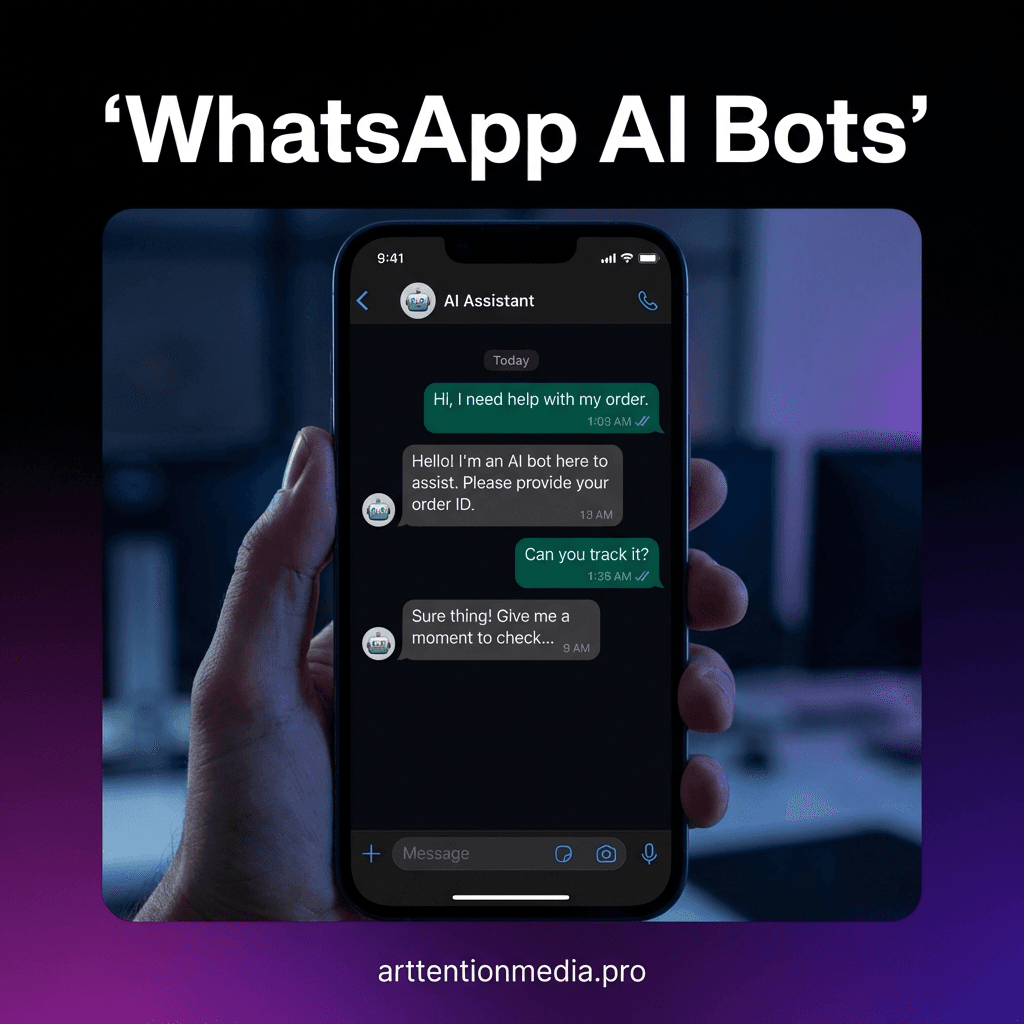
While most businesses are still debating whether to use WhatsApp for customer service, smart companies have already deployed AI chatbots that handle thousands of conversations simultaneously. These aren't simple auto-responders—they're sophisticated AI agents that understand context, maintain conversation history, and deliver personalized experiences at scale.
WhatsApp Business API combined with advanced AI creates the most powerful customer engagement platform available today. The numbers speak for themselves: messages have a 98% open rate compared to 20% for email, and customers prefer messaging over phone calls by a ratio of 3:1. The businesses capitalizing on this shift are seeing dramatic improvements in customer satisfaction, response times, and operational efficiency.
Why WhatsApp AI Chatbots Outperform Traditional Customer Service
The effectiveness of WhatsApp AI chatbots stems from the convergence of user behavior preferences and advanced AI capabilities. Unlike email or phone support, WhatsApp operates in real-time with the familiarity of personal messaging, while AI provides the intelligence to handle complex customer needs without human intervention.
Instant Response Without Human Limitations
Traditional customer service operates within business hours and depends on staff availability. WhatsApp AI chatbots provide instant responses around the clock, handling inquiries ranging from simple FAQ questions to complex troubleshooting scenarios. These systems can simultaneously manage hundreds of conversations, each with full context and personalization.
Advanced AI chatbots understand natural language, interpret intent, and access business systems to provide accurate, contextual responses. When a customer asks about their order status, the AI doesn't just acknowledge the request—it checks the order system, provides detailed tracking information, and proactively offers solutions if delays are detected.
Persistent Context and Memory
Unlike phone calls that start fresh each time, WhatsApp conversations maintain persistent history. AI chatbots leverage this continuity to build deeper understanding of each customer's situation, preferences, and previous interactions. This context awareness enables increasingly sophisticated support that improves over time.
Smart chatbots remember not just what customers said, but what they needed, how they prefer to communicate, and what solutions worked previously. This creates a personalized experience that feels more like talking to a knowledgeable friend than a support system.
Advanced WhatsApp AI Chatbot Capabilities
Modern WhatsApp AI chatbots extend far beyond simple question-and-answer interactions. They integrate with business systems, execute complex workflows, and provide proactive customer engagement that drives business outcomes.
Multi-System Integration
Sophisticated WhatsApp AI chatbots connect to CRM systems, inventory management, scheduling platforms, and payment processors. This integration enables them to handle complete customer journeys within the messaging interface—from initial inquiry through purchase and post-sale support.
- Real-time inventory checks and product recommendations
- Appointment scheduling with calendar integration
- Order processing and payment collection
- Support ticket creation and status updates
- Customer data updates and preference management
Proactive Customer Engagement
The most advanced WhatsApp AI chatbots don't wait for customers to reach out. They monitor business events and customer behavior to initiate valuable conversations at optimal moments. This might include order confirmations, shipping updates, appointment reminders, or personalized product suggestions based on purchase history.
Proactive messaging feels natural on WhatsApp because it mimics how people actually use the platform. Customers expect updates and communications through their preferred messaging app, making AI-initiated conversations feel helpful rather than intrusive.
Multimedia and Rich Media Support
WhatsApp AI chatbots can send and receive images, videos, documents, and audio messages. This capability enables visual problem-solving, document collection for onboarding, video explanations of complex processes, and voice-based interactions for accessibility.
Customers can photograph products for visual search, send documents for processing, or receive video tutorials tailored to their specific questions. This multimedia approach solves problems that text-only interfaces struggle with.
Implementation Strategies for Different Business Models
The specific implementation of WhatsApp AI chatbots varies significantly based on business model, customer base, and operational requirements. Successful deployments align chatbot capabilities with business objectives and customer expectations.
E-commerce and Retail
Retail businesses use WhatsApp AI chatbots as personal shopping assistants that understand customer preferences, browse inventory, process orders, and handle post-purchase support. These chatbots can recommend products based on conversation context, handle size and color variations, and even upsell complementary items.
Advanced implementations include visual search capabilities where customers can photograph items they like to find similar products, automated return processing, and personalized styling advice based on purchase history and stated preferences.
Service-Based Businesses
Service businesses leverage WhatsApp AI chatbots for appointment booking, service explanation, quote generation, and customer onboarding. These systems can understand service requirements from natural language descriptions, check provider availability, and coordinate scheduling across multiple team members.
Professional service firms use chatbots to qualify prospects, collect project requirements, and provide initial consultations. The AI can ask clarifying questions, explain service options, and prepare detailed briefs for human experts.
SaaS and Technology
Technology companies deploy WhatsApp AI chatbots for user onboarding, technical support, feature education, and account management. These systems can walk users through setup processes, troubleshoot technical issues, and provide contextual help based on user behavior patterns.
Advanced implementations include integration with user analytics to provide proactive support before users encounter problems, automated billing support, and feature adoption guidance based on user usage patterns.
Technical Architecture for WhatsApp AI Chatbots
Building effective WhatsApp AI chatbots requires careful architecture that balances performance, reliability, and intelligence. The system must handle real-time messaging at scale while maintaining conversation context and integrating with business systems.
Message Processing Pipeline
Robust WhatsApp AI chatbots use event-driven architectures that can process incoming messages, maintain conversation state, execute business logic, and send responses within seconds. This requires efficient message queuing, conversation management, and response generation systems.
The architecture typically includes webhook handlers for incoming messages, conversation context databases, AI model inference systems, business system integrations, and response delivery mechanisms. Each component must be optimized for low latency and high availability.
Conversation State Management
Unlike stateless web interactions, WhatsApp conversations require persistent state management. The system must track conversation history, user preferences, partial transactions, and context across potentially long-running customer relationships.
Advanced implementations use vector databases to maintain semantic understanding of conversation context, enabling AI models to reference relevant information from previous interactions even when conversations span days or weeks.
AI Model Integration
Modern WhatsApp AI chatbots integrate multiple AI models for different capabilities. This might include large language models for conversation, specialized models for intent classification, computer vision models for image processing, and speech recognition for voice messages.
The key is orchestrating these models efficiently while maintaining response speed. Smart implementations use model routing based on message type and complexity, caching for common responses, and fallback strategies for model failures.
Measuring Success and Optimization
WhatsApp AI chatbot success extends beyond simple metrics like response time or message volume. The most important indicators relate to customer satisfaction, business outcomes, and operational efficiency improvements.
Customer Experience Metrics
- Resolution rate for customer inquiries without human escalation
- Customer satisfaction scores for chatbot interactions
- Average conversation length and completion rates
- Return customer engagement and retention
- Time savings compared to traditional support channels
Business Impact Indicators
The most valuable WhatsApp AI chatbots drive measurable business outcomes. This includes conversion rate improvements from better customer engagement, cost savings from reduced human support needs, and revenue growth from enhanced customer experiences.
Advanced implementations track leading indicators like conversation quality scores, successful transaction completions, and customer journey progression to optimize both AI performance and business results.
Common Implementation Challenges and Solutions
While WhatsApp AI chatbots offer significant advantages, successful implementation requires addressing specific challenges related to messaging platforms, customer expectations, and technical complexity.
Message Rate Limits and Scalability
WhatsApp Business API has specific rate limits and messaging policies that affect chatbot design. Successful implementations work within these constraints while maintaining responsive user experiences. This includes intelligent message batching, priority queuing for urgent communications, and graceful degradation when limits are approached.
Managing Customer Expectations
Customers approach WhatsApp with expectations formed by personal messaging experiences. They expect immediate responses, natural conversation flow, and seamless problem resolution. Setting clear expectations about AI capabilities while delivering consistently excellent experiences is crucial for adoption and satisfaction.
Integration Complexity
WhatsApp AI chatbots are most valuable when integrated with existing business systems. However, this integration can be technically challenging, especially with legacy systems or complex business workflows. Successful implementations use API-first architectures and invest in robust integration testing.
The Future of WhatsApp Business AI
WhatsApp AI chatbots represent the beginning of a broader transformation in business communication. As AI models become more sophisticated and messaging platforms add new capabilities, we're moving toward conversational business interfaces that feel more natural and capable than traditional customer service.
The businesses investing in WhatsApp AI chatbots today are building foundational capabilities for the future of customer engagement. They're not just improving current operations—they're establishing competitive advantages in an increasingly message-first business world.
The question isn't whether messaging will become the primary business communication channel. It's whether your business will lead or follow this inevitable transformation.
Frequently Asked Questions
How do WhatsApp AI chatbots differ from website chatbots?
WhatsApp chatbots maintain persistent conversation history, work within the app customers already use daily, and can send proactive messages. They feel more personal and accessible than website chatbots, leading to higher engagement and completion rates.
What types of businesses benefit most from WhatsApp AI chatbots?
Any business with regular customer interactions benefits, especially e-commerce, service providers, restaurants, healthcare, and education. The key is having customers who prefer messaging over phone calls or email.
How complex is it to implement a WhatsApp AI chatbot?
Implementation complexity depends on required integrations and AI sophistication. Basic chatbots can be deployed quickly, while advanced systems with business system integration require more development time and technical expertise.
Can WhatsApp AI chatbots handle multiple languages?
Yes, modern AI models support multiple languages within the same conversation. The chatbot can detect customer language preference and respond appropriately, making it ideal for businesses with diverse customer bases.
What are the costs associated with WhatsApp Business API?
WhatsApp Business API charges based on conversation volume and message types. Costs vary by region and usage patterns, but most businesses find the ROI positive due to reduced support costs and improved customer satisfaction.
Take it further with Arttention Media
Explore the services behind the ideas in this article:
Mathew Munyao
Founder, Arttention Media
Mathew is the founder of Arttention Media, an AI-powered digital agency serving businesses globally. With 6+ years in digital marketing and AI, he leads a team that has deployed dozens of websites, generated hundreds of qualified leads for clients worldwide, and built custom AI agents for businesses across multiple continents.
Ready to grow your business?
Book a free consultation — no pressure, just honest advice about what will work for your industry.
Book a Free Consultation →