Why Most Businesses Fail at AI (And How to Get It Right)
Mathew Munyao
Founder, Arttention Media
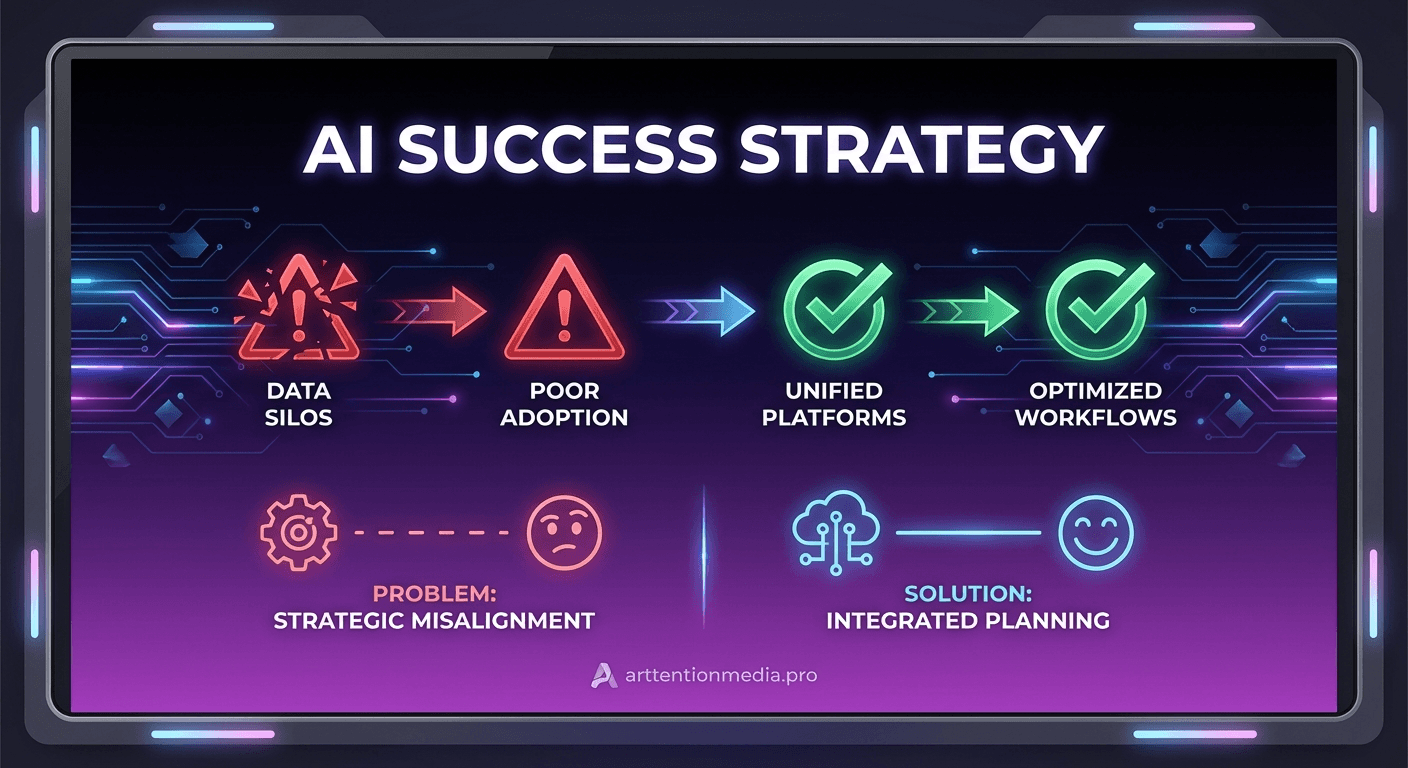

The statistics on AI implementation failures are sobering. Studies show that 70-85% of AI projects fail to deliver expected results. Businesses invest significant time and money into AI initiatives, only to abandon them when they don't work as promised.
These failures aren't because AI technology isn't ready. The same AI models powering failed projects are also powering successful implementations at other companies. The difference isn't the technology — it's the approach. Here's why most businesses fail at AI and what successful implementations do differently.
Starting with the Wrong Problems
Most AI failures start with poor problem selection. Businesses choose problems that are too complex, too vague, or not well-suited for AI solutions. They want to "use AI for customer service" or "automate sales" without defining specific, measurable outcomes.
Successful AI implementations start with narrow, well-defined problems that have clear success criteria. Instead of "improve customer service," they target "reduce response time to under 5 minutes for common support questions." Instead of "automate sales," they focus on "qualify inbound leads and schedule appointments automatically."
The best AI projects solve problems that are routine, high-volume, and rule-based. These characteristics make them perfect for automation. Complex, creative, or judgment-heavy tasks are poor starting points for AI implementation.
Unrealistic Expectations About AI Capabilities
Media coverage of AI creates unrealistic expectations about what current technology can do. Businesses expect AI systems to work like human employees — understanding context perfectly, handling any situation, and learning from experience autonomously.
Current AI systems excel at specific tasks but struggle with general intelligence. They can schedule appointments perfectly but can't handle complex negotiations. They can answer product questions accurately but can't provide strategic business advice.
Successful implementations align expectations with reality. They use AI for what it does well — pattern recognition, data processing, consistent execution — while keeping humans involved for judgment, creativity, and relationship management.
Inadequate Data Preparation
AI systems are only as good as the data they can access. Most businesses underestimate the importance of data quality, thinking they can feed AI systems whatever information they have and get good results.
Poor data quality is the number one technical reason for AI project failures. Incomplete records, inconsistent formatting, missing information, and outdated data create AI systems that give wrong answers or take incorrect actions.
Successful AI implementations invest significant effort in data preparation before building AI systems. They clean existing data, establish data quality standards, and create processes to maintain data accuracy over time.
Lack of Integration Planning
Many AI projects fail because they're built as isolated systems that don't integrate well with existing business processes. The AI might work technically but doesn't fit into daily operations.
Staff don't know how to work with the AI system. Customers encounter friction when the AI hands off to human agents. Data doesn't flow between the AI and existing business tools. These integration problems make AI systems feel like obstacles rather than helpful tools.
Successful implementations plan integration from the beginning. They design AI systems that work within existing workflows, train staff on human-AI collaboration, and ensure seamless data flow between all business systems.
Insufficient Change Management
Deploying AI systems requires significant changes to business processes and staff responsibilities. Most businesses underestimate the change management required, focusing on technology implementation while neglecting organizational adaptation.
Staff resistance is common when AI systems are introduced without proper training and communication. People worry about job security, feel confused about new processes, or simply resist changing familiar routines.
Successful implementations include comprehensive change management. They communicate benefits clearly, train staff thoroughly, address concerns openly, and gradually introduce AI systems to allow adaptation time.
Technology-First Instead of Business-First Thinking
Many AI projects start with excitement about technology capabilities rather than specific business needs. Teams explore what AI can do instead of starting with what the business needs to accomplish.
This approach leads to solutions looking for problems. The AI system might be technically impressive but doesn't solve important business challenges or generate measurable value.
- Start with specific business problems, not AI capabilities
- Define success metrics before beginning implementation
- Focus on return on investment, not technical sophistication
- Choose simple solutions that work over complex systems that don't
- Measure business outcomes, not technical achievements
- Prioritize user adoption over feature completeness
- Scale successful solutions instead of building new ones
Successful AI implementations start with clear business objectives and work backward to find appropriate technical solutions. They choose the simplest AI approach that solves the problem effectively.
Inadequate Testing and Validation
Many AI systems fail because they're deployed without sufficient testing in real-world conditions. Lab testing and limited pilot programs don't reveal all the edge cases and integration challenges that occur in production.
AI systems behave differently under real-world load, with real customer data, and integrated with actual business processes. Problems that don't appear during testing can cause major failures when the system goes live.
Successful implementations include extensive testing phases with gradual rollouts. They start with limited scope, monitor performance closely, and expand gradually as the system proves reliable.
Neglecting Ongoing Maintenance and Optimization
AI systems aren't set-and-forget solutions. They require ongoing monitoring, maintenance, and optimization to continue performing well as business conditions change.
Many businesses deploy AI systems and then ignore them until problems occur. Performance degrades over time as data patterns change, business processes evolve, or integration points break.
Successful AI implementations include ongoing management processes. They monitor system performance continuously, update training data regularly, and optimize workflows based on usage patterns.
How to Get AI Implementation Right
Successful AI implementations follow a proven pattern. They start small with well-defined problems, invest in data quality, plan integration carefully, and scale gradually based on results.
The most successful approach is to identify one specific, high-impact process that's currently manual and time-consuming. Map the current process thoroughly, define success criteria clearly, and design an AI solution that automates the routine elements while preserving human oversight.
Start with a pilot implementation that affects a limited number of customers or transactions. Monitor performance closely, gather feedback from users, and refine the system based on real-world usage before expanding.
Building AI Competency Within Your Organization
Long-term AI success requires building internal competency, not just implementing individual systems. Teams need to understand AI capabilities and limitations, learn to identify good AI use cases, and develop skills for working with AI systems effectively.
This doesn't mean everyone needs to become an AI expert. But key staff should understand enough about AI to make good decisions about when and how to use it.
Start with training for managers and decision-makers about AI capabilities, limitations, and best practices. Include hands-on experience with AI tools relevant to your industry. Build understanding gradually through successful small projects before attempting larger implementations.
Choosing the Right Implementation Partner
Most businesses should work with experienced AI implementation partners rather than trying to build everything in-house. But choosing the right partner is crucial for success.
Look for partners who focus on business outcomes rather than technical features. They should start by understanding your business processes and challenges, not pitching their latest AI capabilities.
The best implementation partners have experience with businesses similar to yours, can provide references from successful projects, and include ongoing support as part of their service. They should be able to explain their approach in business terms, not just technical jargon.
Our first AI project failed because we started with the technology and tried to find uses for it. Our second project succeeded because we started with a specific business problem and used AI to solve it.
Measuring AI Success Correctly
Many businesses struggle to measure AI success because they focus on technical metrics instead of business outcomes. System accuracy, response times, and uptime are important but don't directly measure business value.
Successful AI implementations track business metrics: cost reduction, revenue increase, customer satisfaction improvement, or capacity expansion. These outcomes justify the investment and guide future AI initiatives.
Set baseline measurements before implementing AI so you can measure actual improvement. Track both short-term operational metrics and longer-term business outcomes to understand full impact.
The Path Forward
AI implementation doesn't have to be risky or expensive. The businesses succeeding with AI start small, focus on specific problems, and scale based on results. They treat AI as a business tool, not a technology experiment.
The key is starting with problems that AI solves well: routine, high-volume, rule-based tasks. Success with these foundational applications builds competency and confidence for more sophisticated implementations later.
The businesses that get AI right will have significant competitive advantages as the technology continues improving. Those that continue avoiding AI or implementing it poorly will fall further behind as customer expectations and competitive pressures increase.
FAQ
What's the most common reason AI projects fail?
Poor problem selection. Most failures start with choosing problems that are too complex, vague, or unsuitable for current AI capabilities. Success comes from starting with narrow, well-defined problems with clear success criteria.
How can we avoid the common pitfalls in AI implementation?
Start small with specific problems, invest in data quality, plan integration carefully, include proper change management, and focus on business outcomes rather than technical features. Work with experienced partners who understand your industry.
How do we know if our business is ready for AI implementation?
You're ready if you have specific, routine processes that consume significant time, clean data about those processes, and management commitment to supporting implementation. You don't need perfect data or processes — just good enough to start.
Should we build AI capabilities in-house or work with external providers?
Most businesses should start with experienced external providers to build their first successful implementations, then gradually develop internal capabilities. Building AI expertise from scratch is expensive and risky without proven use cases.
How long should we expect before seeing results from AI implementation?
Well-designed AI implementations typically show operational improvements within 4-8 weeks and measurable business results within 3-6 months. If you're not seeing benefits within this timeframe, the implementation likely needs adjustment.
Take it further with Arttention Media
Explore the services behind the ideas in this article:
Mathew Munyao
Founder, Arttention Media
Mathew is the founder of Arttention Media, an AI-powered digital agency serving businesses globally. With 6+ years in digital marketing and AI, he leads a team that has deployed dozens of websites, generated hundreds of qualified leads for clients worldwide, and built custom AI agents for businesses across multiple continents.
Ready to grow your business?
Book a free consultation — no pressure, just honest advice about what will work for your industry.
Book a Free Consultation →